Cats and Trails and Garden Tales
Musings on cats, travel, gardens and life
A Tiger in the Grass
I found a handsome Tiger resting in the grass where the catmint will soon be in bloom.
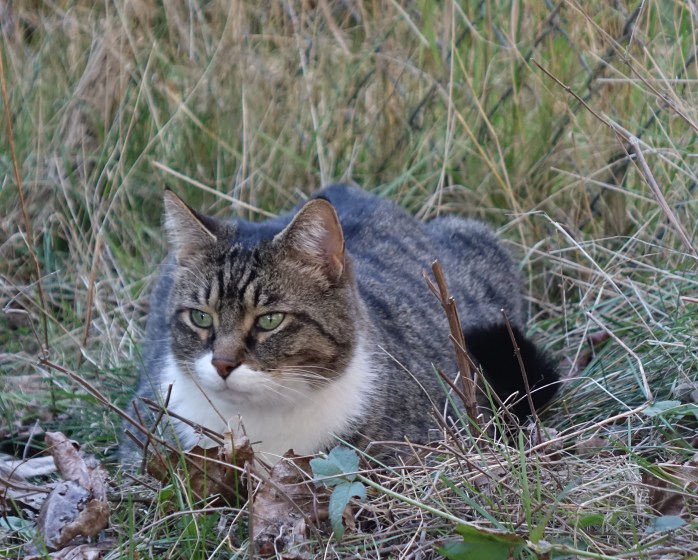
~ Susanne
Today’s Garden Story in Pictures
For this week’s photo challenge I give you a story of gardening with the handsome Benji.
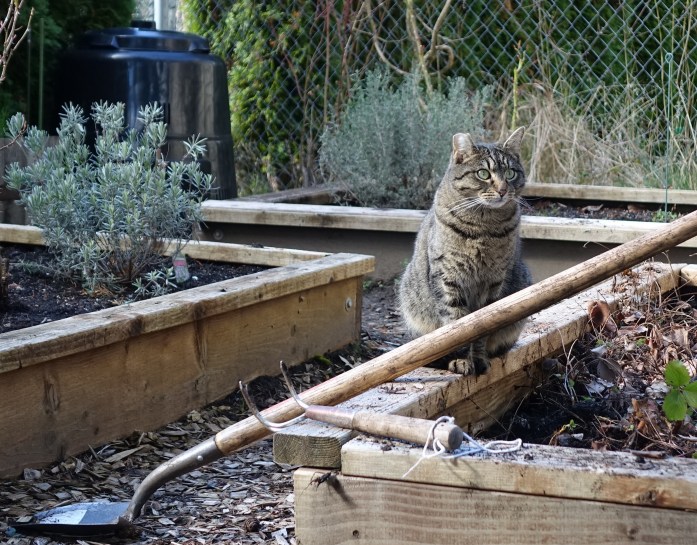
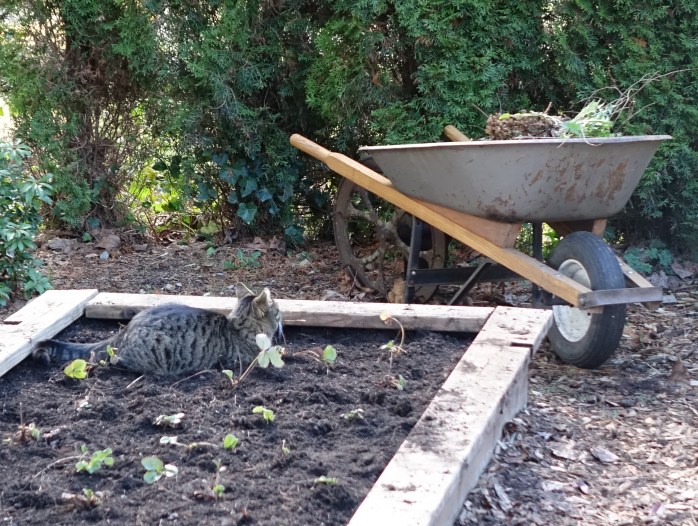
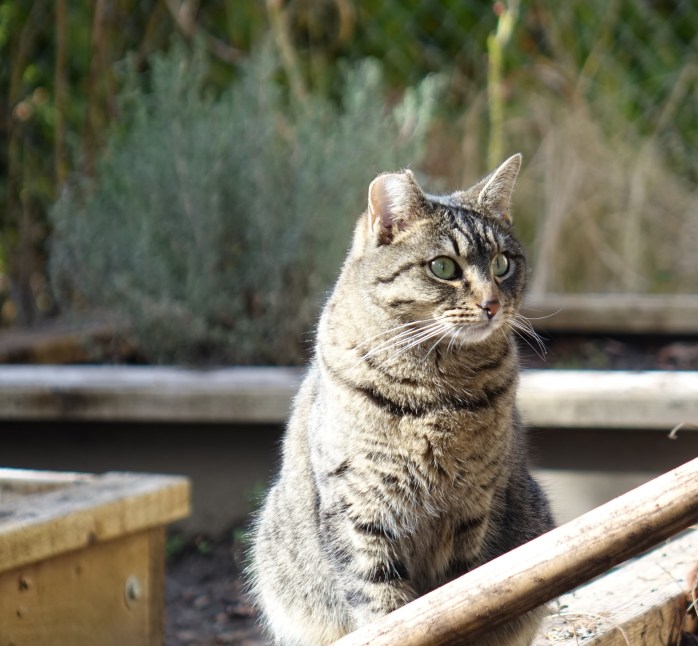
~ Susanne and Benji
Stretchy Benji
Hey Benji, I need my chair. Why don’t you go into the other room where you can stretch out?
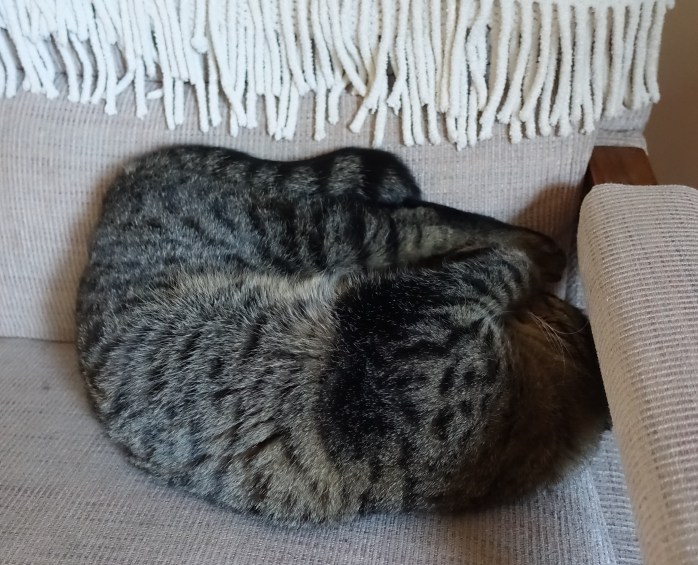

Thanks.
~ Susanne and Benji
Winter Walk at Coulon Park
It hardly seems fair to call it a winter day, not with temperatures in the 50’s and the sky as blue as the lake below. And though the calendar does indeed say it’s winter I put on my lighter jacket and we headed to one of our favorite walks at nearby Gene Coulon Park in Renton. With fresh air, sunshine, paved trail, lake and mountain views, there’s always something new to see. Today it was men in orange suits engaged in a training exercise; not a bad day’s work I would say.

Further on I stopped to enjoy the happy sailboats all lined up and buttoned down, waiting patiently for someone to take them out.
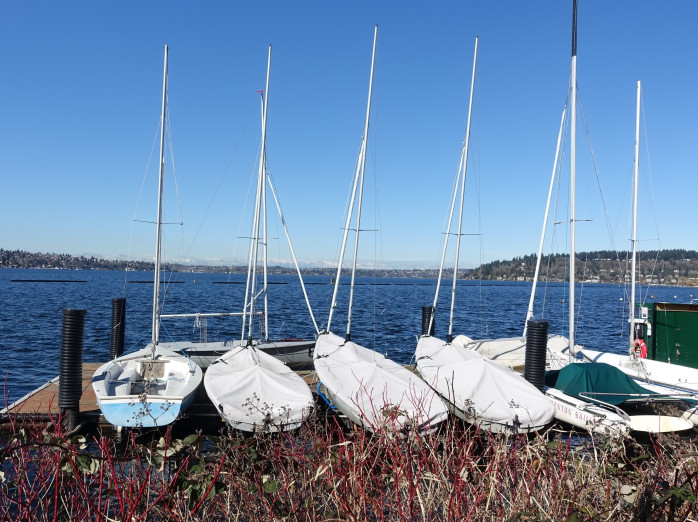
Mt. Rainier made an appearance in the south, which was much appreciated.

And this stream harbored birdsong sounding like a reed – what bird is that? – as it flowed into the lake.

Happy for another sunny winter walk.
~ Susanne
Discovering Chambers Bay
Chambers Bay brings to mind the US Open Golf Tournament – at least to us locally – which was played there in 2015. I’m not much of a golfer but my husband is so we watched the TV coverage of the event. I remember at the time some of the golfers complained about the course; that it was bumpy, and didn’t have the smooth variety of grass they were accustomed to. (One said it was like playing on broccoli.) I thought it was rather strange-looking myself at the time and not representative of the beauty of the Pacific Northwest, nor similar to the greens I’d seen at other courses. Even so, we finally visited Chambers Bay last weekend when we were looking for someplace new to walk and surprisingly, we loved it!
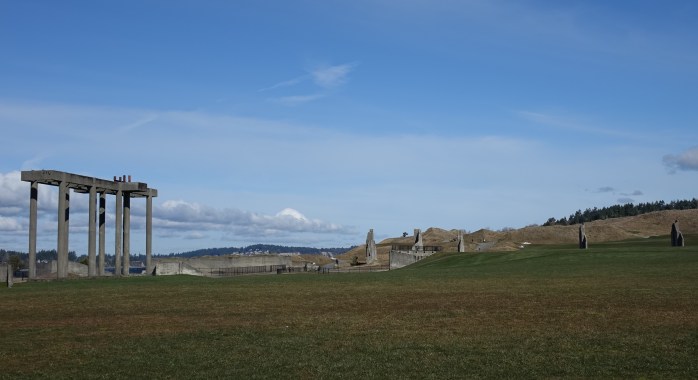
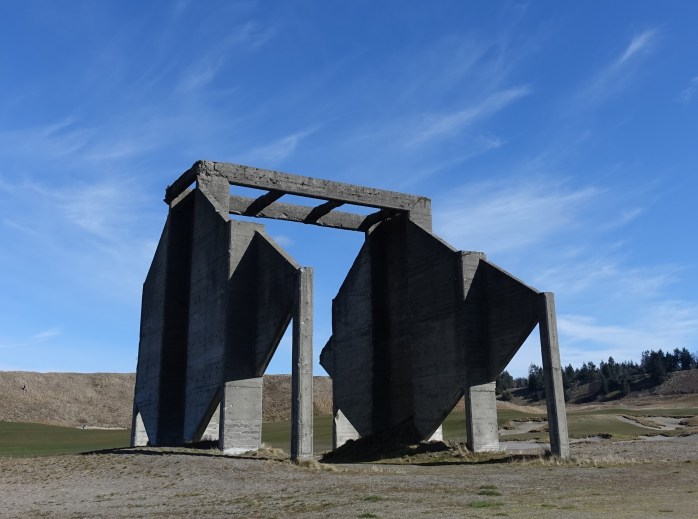
In addition to the golf course at Chambers Bay, there’s also a park with wide paved trails that wind around the course, through patches of woods and along the saltwater shoreline, with wonderful views of the mountains and Puget Sound. There are also wide open spaces and towering old structures – relics from another era when the area was a sand and gravel quarry. According to the Washington Post, “For 100 years starting in 1902, sand and gravel — formed by the outwashes of prehistoric rivers flowing out of Ice Age glaciers — was loaded onto barges in Puget Sound or onto hopper rail cars on the shore and sent all over the Pacific Northwest for construction projects.” In 2002 the abandoned quarry became a highly regarded public golf course, and was awarded the US Open.

We traveled the 45 minutes south to University Place near Tacoma under sunshine and clear skies. Though a bit chilly, it was a perfect day for a walk. There are a couple of different paths you can take in the park depending on how much of a hill climb you want. We decided to take the Loop Trail which included the hills, but was still an easy walk of 3.25 miles. We started at the top overlooking the course and found the golden colors striking against the deep blue of Puget Sound. Not the typical dark green grass you expect on a golf course, but apparently easier to maintain. We headed down and around the golf course and through the woods toward the shoreline.
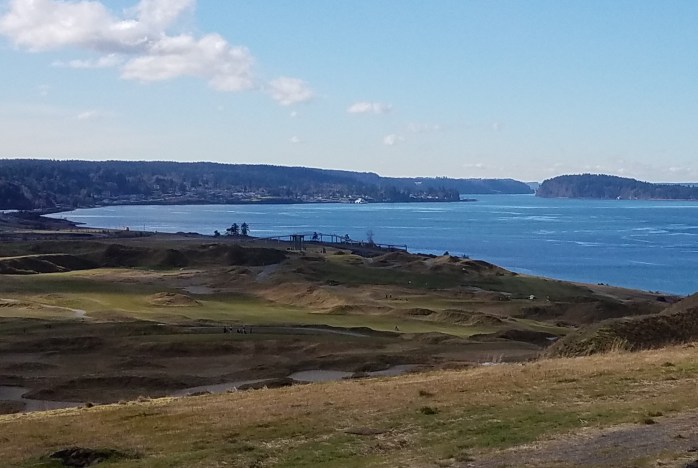
We stopped near the bottom to watch the golfers, and also to watch out for ourselves, their high-flying golf balls overhead, just as the sign warned.
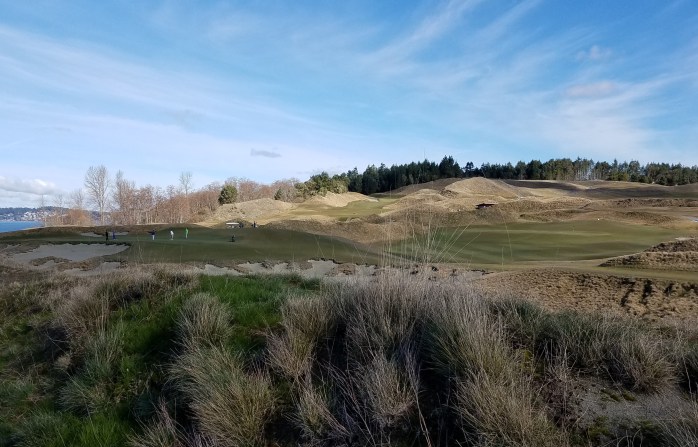
As we reached the bottom we realized what the structure was that we’d seen from the top: an overpass to the beach, crossing over the railroad tracks. We didn’t descend the steps to the beach like many did with their children and dogs. One ‘parent’ carried his scared dog over the bridge and released him to run free on the beach below.
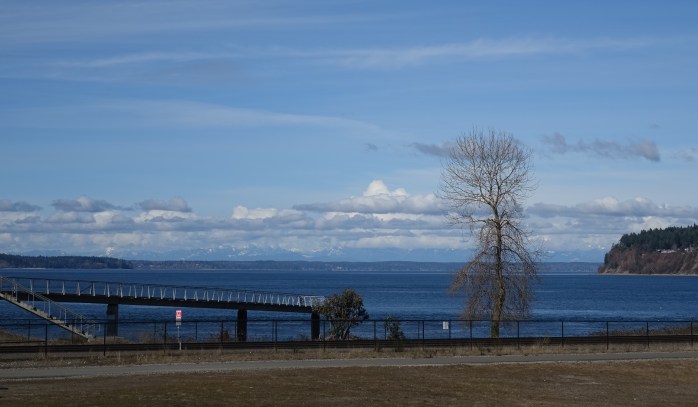
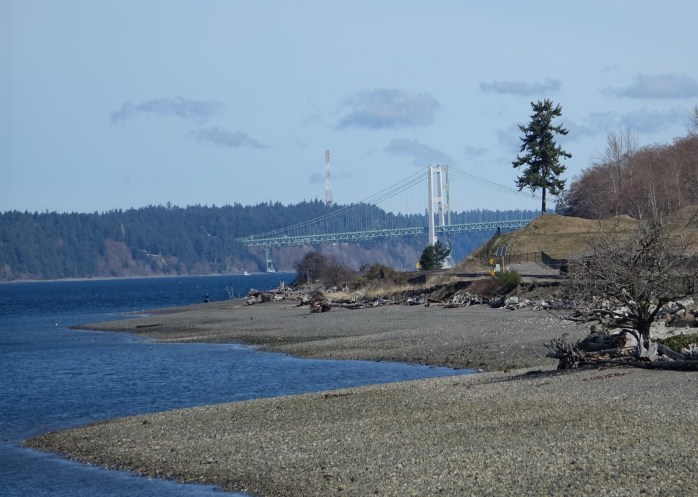
We walked to the end of the overpass where it jutted out over the water, and had nice views of the Tacoma Narrows Bridge to the north.

Further up the Trail we came across many interesting structures from the earlier quarry days – like walking through ancient Greece I thought.
We continued on the Loop Trail and back up the hill getting our exercise for the day before heading out to lunch. We’d found another new place to walk and promised ourselves we’d be back.
~ Susanne
Side by Side
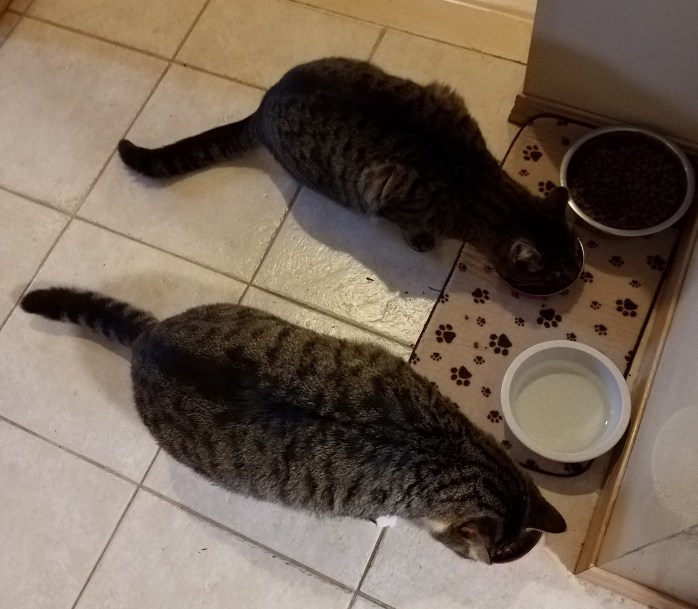
This is Benji and life is good for me and Tiger. Our day begins very early when Bob lets us outside when it’s still dark and Sue is sleeping. We chase the small ones in the bush and watch the birds come to life as the sun slowly rises. After we finish our business we come back in and wait for Sue to give us our breakfast; it’s her job. She knows this so I don’t feel bad waking her.
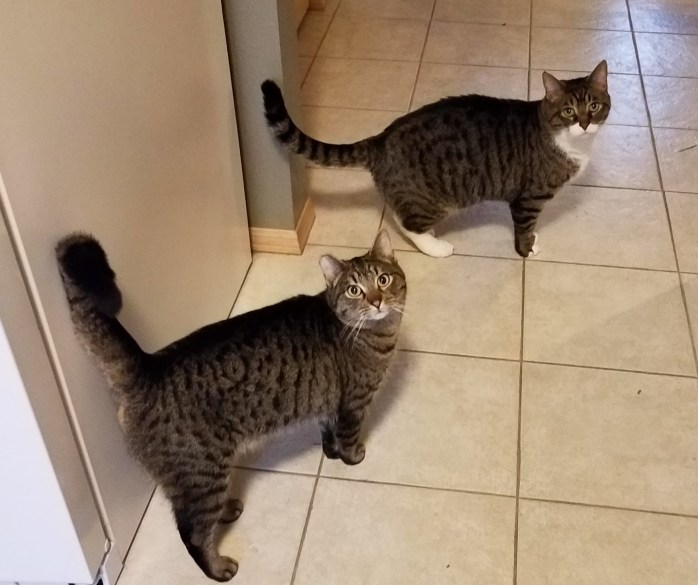
She gives us Fancy Feast in equal portions, but whatever Tiger leaves behind I am happy to finish up. He is slow and somewhat overweight which comes with age I guess.
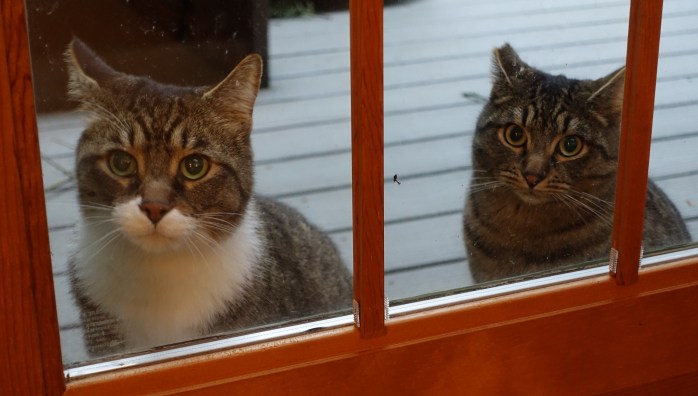
After breakfast we go outside again to play until it’s too cold and we want back in – this may happen several times a day. Sue obliges though sometimes not as quickly as we’d like.
In the afternoon we play with our toys. We especially like the red catnip mouse.
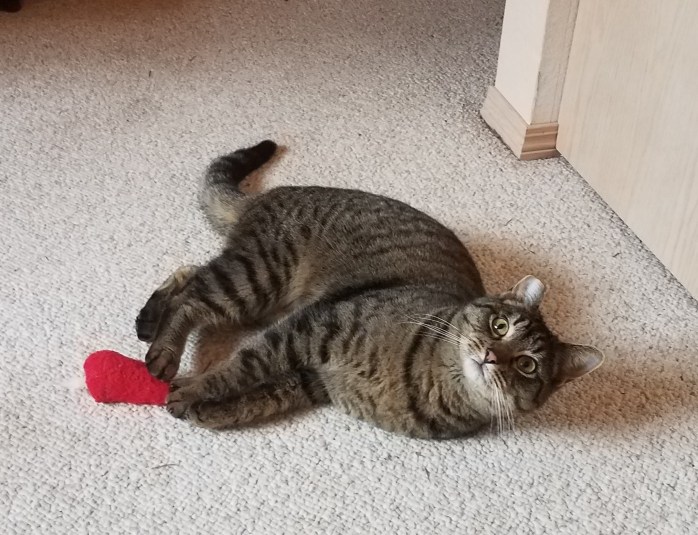

When we get tired we take our afternoon nap.
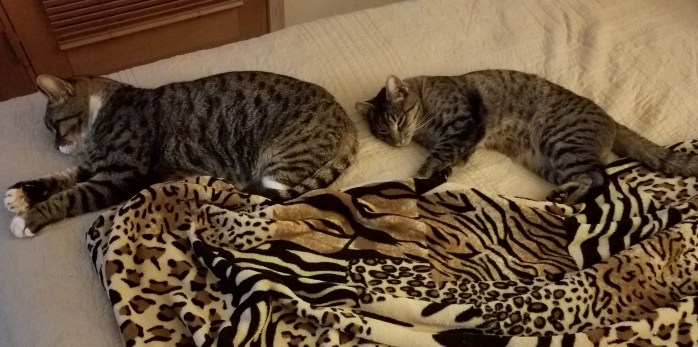
It’s a side by side life.
~ Benji and Tiger
March comes in on a Whisper
There’s no lion today; March has come to the Pacific Northwest with barely a whisper and blue skies. We take advantage of the milder temperatures with a walk on the Cedar River Trail.

We see bursts of color in the trees and shrubs…

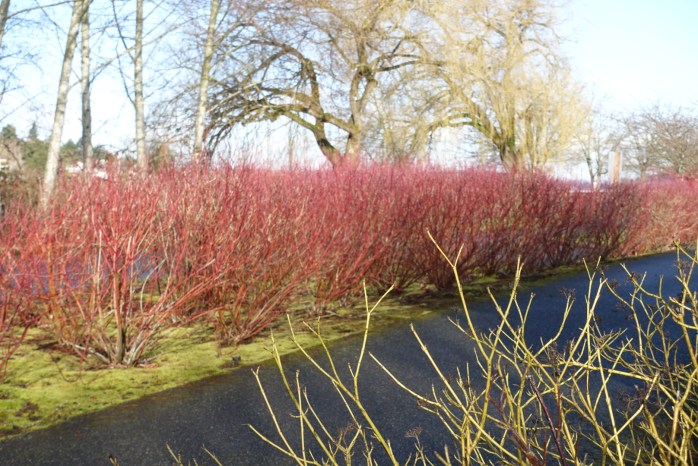
As an eagle soars overhead.

At the end of the trail logs are strewn about where the river flows into Lake Washington.
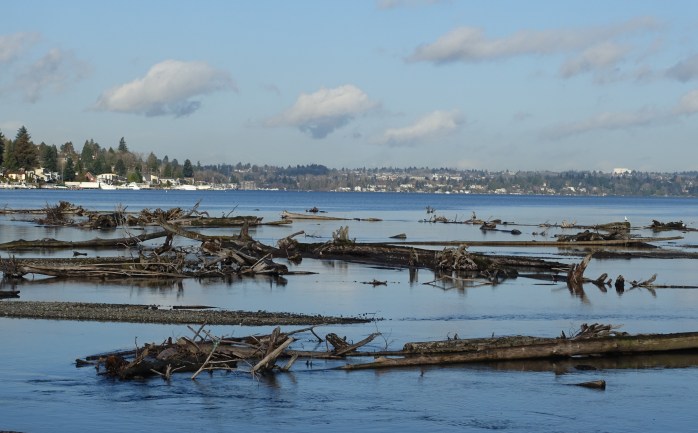
A lovely walk on a March day and hopefully the last we see of winter.
~ Susanne
Shadow Lake Bog: Out of this World
Earlier this winter we visited the nearby Shadow Lake Nature Preserve and its ancient sphagnum moss peat bog where it seemed that creatures might emerge from the swamp and prehistoric birds could soar overhead.


And so for this week’s photo challenge I bring you the bog at Shadow Lake Preserve. It was out of this world.
Please turn out the lights


Thank you.
~ Benji
Gray and Red in Seattle
I always thought Petula Clark had it right, “when you’re alone and life is making you lonely you can always go.. downtown!” I liked the song back in the sixties and even then as a kid I’d hop on a bus downtown for 20 cents. With another dollar or two I could shop and eat at Woolworths and have a full day of cheap entertainment. Little did I know at the time I would spend more than 30 years working in downtown Seattle, whether lonely or not. It wasn’t always as great as the song, but it wasn’t bad either. The work was mostly interesting, my coworkers mostly pleasant, and the coffee always good and plentiful, especially as the years went by and a Starbucks appeared in every lobby.
This week I headed downtown to attend the retirement party of a former coworker. It had been a while. My husband dropped me off at the light rail and I emerged from the tunnel in downtown Seattle 30 minutes later. It was icy cold but I walked to the Sculpture Park soaking in the sights and sounds, both old and new, around town. Today the vibe was gray and red.
The wheel was a nice addition to the waterfront and provides something new for the tourists to do. The ferries still run faithfully back and forth across the Sound while the red cranes add background color.

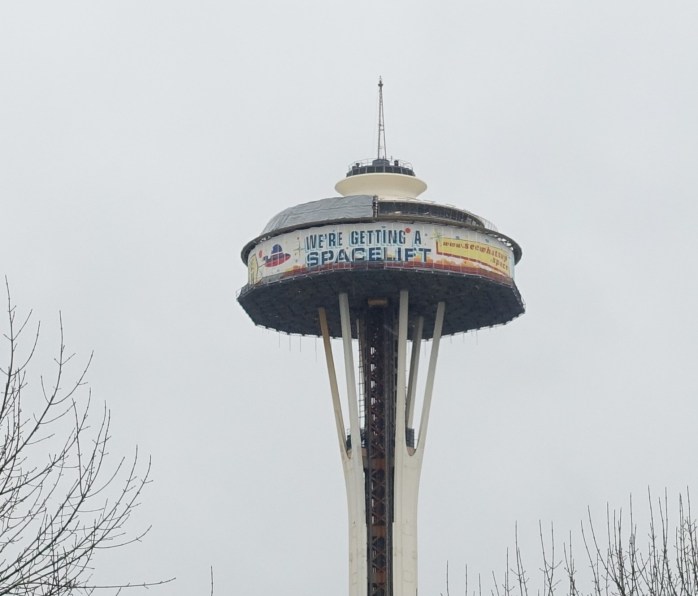
By the time I made it to the Olympic Sculpture Park tiny snowflakes were falling, my face was frozen and I wondered why I’d left my hat and gloves at home. I hurried through the park but still caught the Space Needle through the Eagle.

Honestly, the Space Needle doesn’t look quite like itself these days. while being renovated with a glass floor underneath the revolving restaurant. Guess I won’t be eating there again – though truth be told I only dined there 3 times in as many decades.
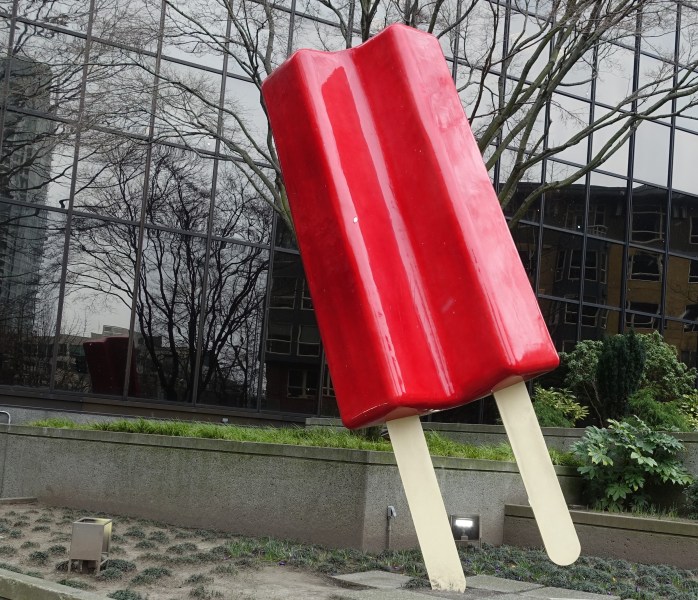
I picked up the pace for the long walk back but still found a giant cherry popsicle – my kind of sculpture.
I found more pops of color at Westlake where food trucks are now a thing.

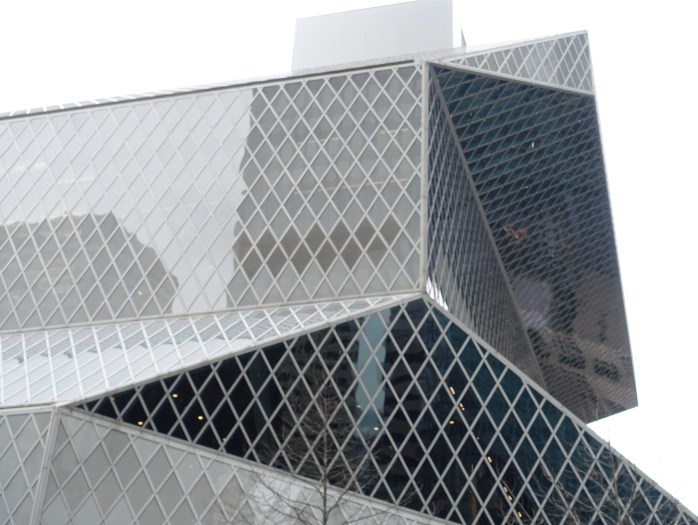
Nearing my destination, I came across the Seattle Public Library and finally appreciated its peculiar shape.

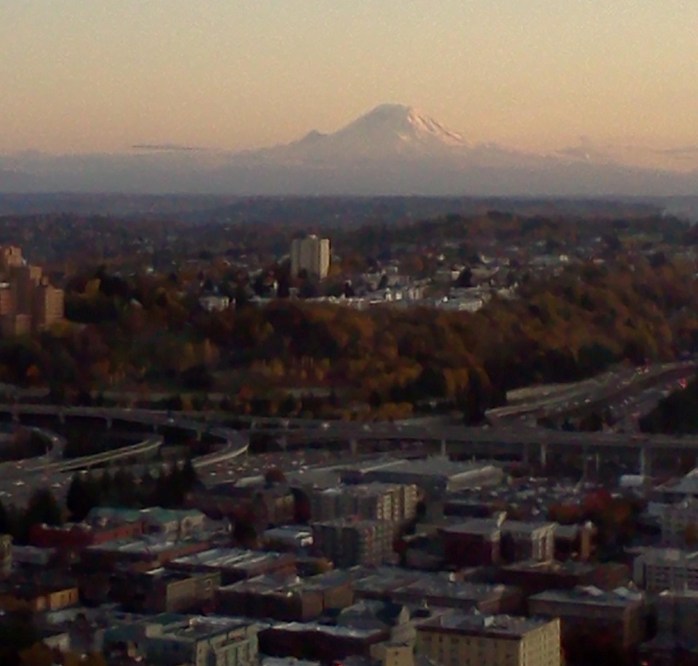
I made it to the Seattle Municipal Tower where my own party had been on the 40th floor some six years earlier. I stopped at the window just as I had many times before on the way to my office. On a clear day you can see Mt. Rainier; early in the morning the sunrise is spectacular, as it was in this photo before I retired.
I wished my friend well – the best computer programmer we ever had I told him. It was a short party of cake and words (this is government after all) and soon the working folks were off to a meeting and invited me to come along. No thanks, I said, I have no interest in attending a configuration meeting. Neither do we, they laughed! And so, we parted, I happy to be retired, they probably wishing they were. Okay, I admit I occasionally miss working; the camaraderie, lunches out, walks on the waterfront; and the satisfaction of accomplishments that can be measured. Still, I wouldn’t go back. Except for another lunch, which I promised them I would do this spring.
~ Susanne
 Cats and Trails and Garden Tales