Cats and Trails and Garden Tales
Musings on cats, travel, gardens and life
A Journal through the American West
Before there were blogs there were journals – remember Lewis and Clark? I too kept a journal on a road trip through the American West, from Seattle to the Black Hills of South Dakota.
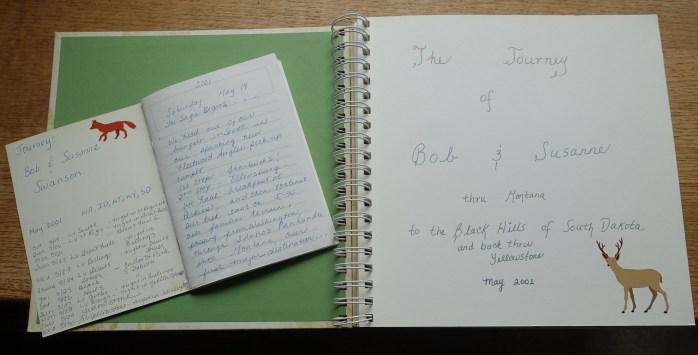
It was a bright day in May when we packed up our camper and left Seattle heading east. We crossed the panhandle of Idaho and spent our first night in St. Regis, Montana, where we woke the next morning to sunshine streaming through the windows, birdsong and rabbits scampering about the campground. What could be better?
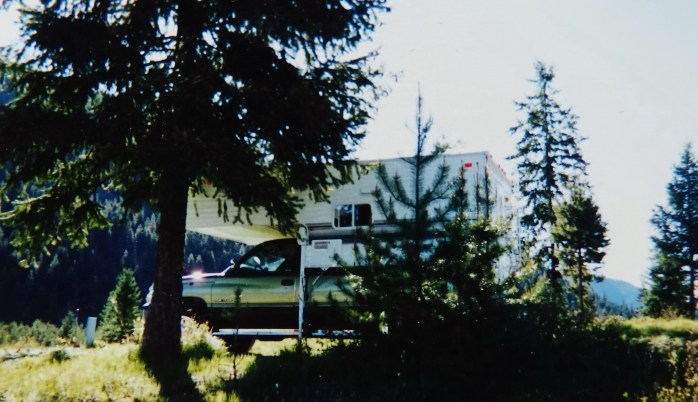
After our morning coffee we proceeded through Big Sky Country, a rugged land of mountains, rivers, and wide open spaces. Our first stop was Helena, where we toured the capitol building and saw Charles Russell’s gorgeous mural, ‘Lewis and Clark meeting the Flathead Indians at Ross Hole.’
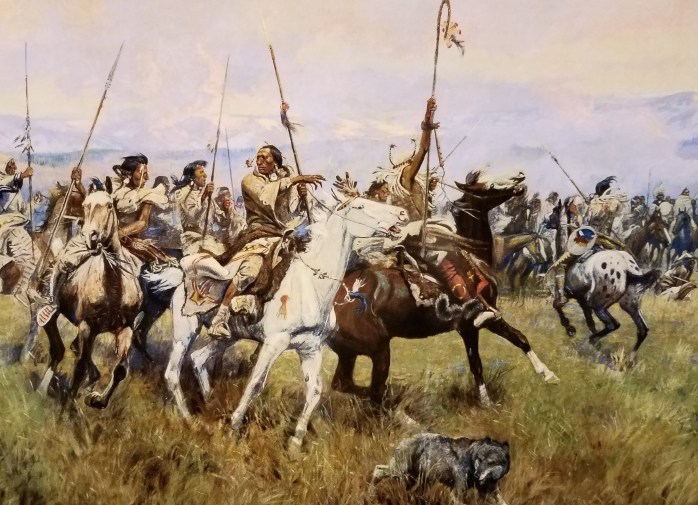
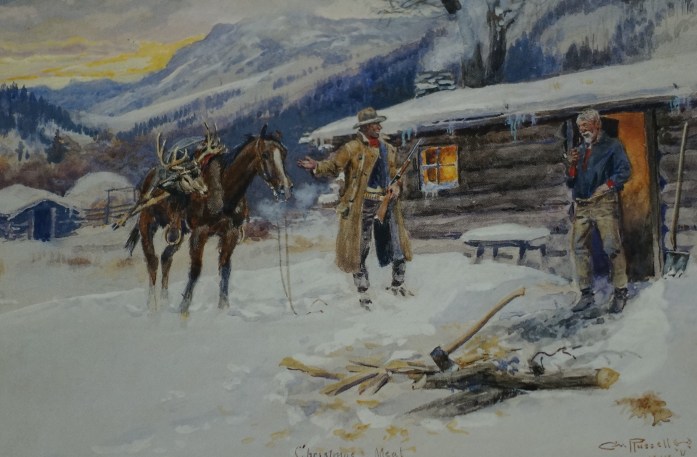
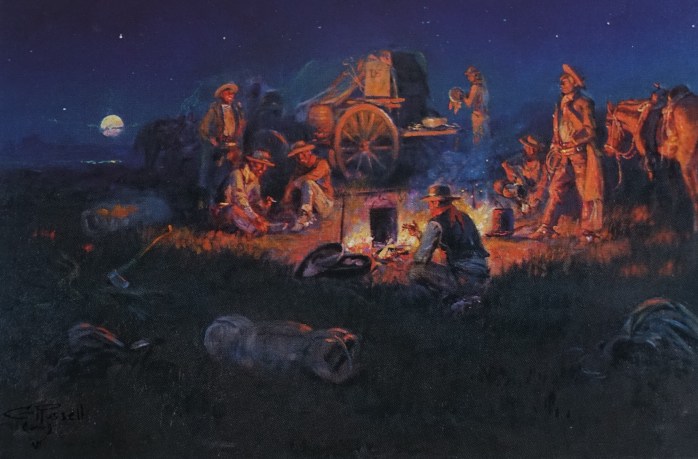
Charles Russell, Western artist and storyteller, was born in St. Louis in 1864 and moved to Montana at the age of 16 to fulfill his dream of becoming a cowboy. He produced over 4000 paintings, drawings and sculptures, of cowboys, the Plains Indians whom he greatly admired, and wildlife, which he called ‘nature’s people.’ We stopped by the CM Russell Museum in Great Falls dedicated to his life and work and I picked up some postcards of his paintings.
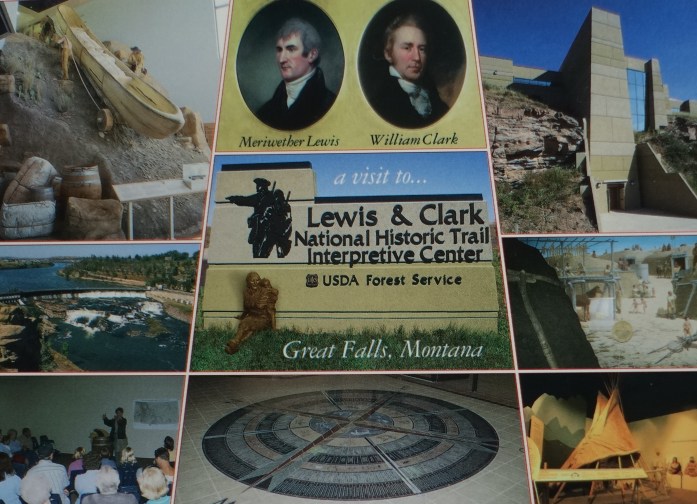
Of course you can’t travel in Montana without reminders of Lewis and Clark. Meriwether Lewis was greatly impressed by the beauty of the Great Falls of the Missouri River calling it “the grandest sight I had ever held.” We visited the Lewis & Clark National Historic Trail Interpretive Center overlooking the Missouri, and nearby Giant Springs, one of the largest freshwater springs in the country.
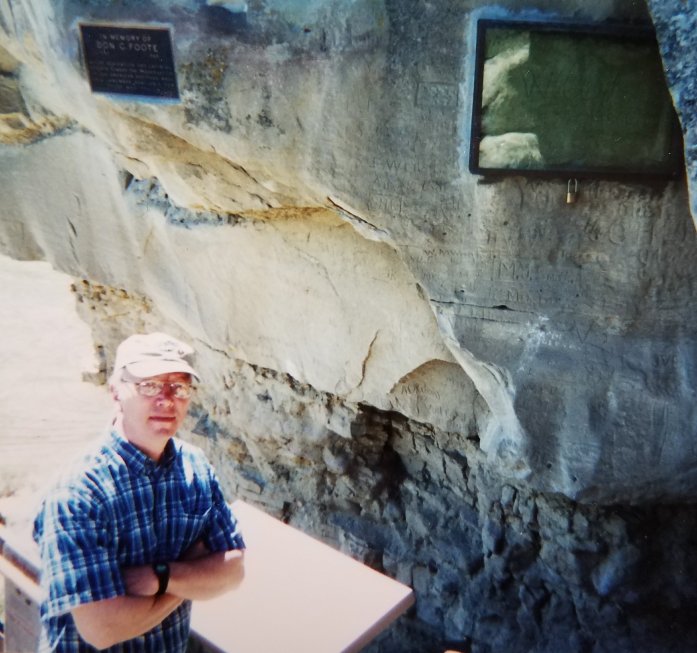
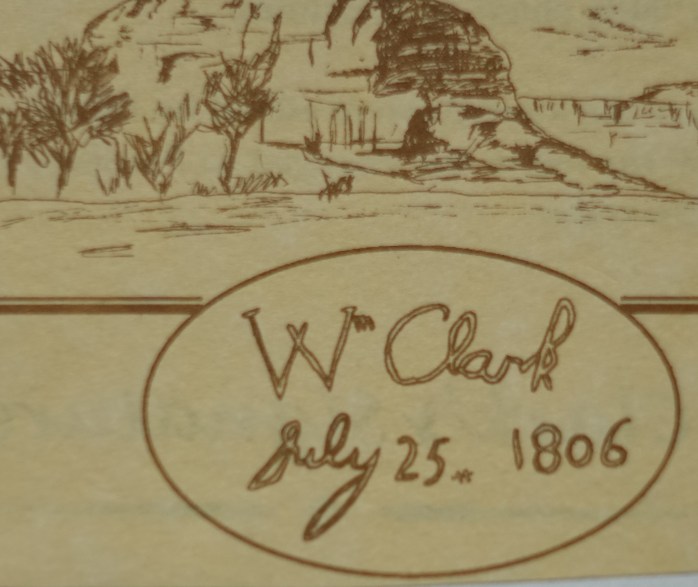
Our final Lewis and Clark stop was at Pompey’s Pillar, east of Billings, a huge outcropping of Sandstone rising 150 ft above the Yellowstone River. It was here Clark carved his name in the rock he named after Sacagawea’s son. The carving is the only remaining physical evidence of the Lewis and Clark expedition.
Clark recorded the event in his journal, “.. at 4 PM I arrived at a remarkable rock… I marked my name and the day of the month & year. July 25th, 1806.”
We took the trail to Pompey’s Pillar to see the carving which is now protected under glass.
Continuing into northeastern Wyoming, it wasn’t long before the landscape changed from the golden, rolling hills of cattle country to green forest and red rock. We’d entered the Black Hills and began to look for the mysterious Devil’s Tower around every turn. When we finally saw it rising above the landscape, it didn’t disappoint (though my pictures might.)
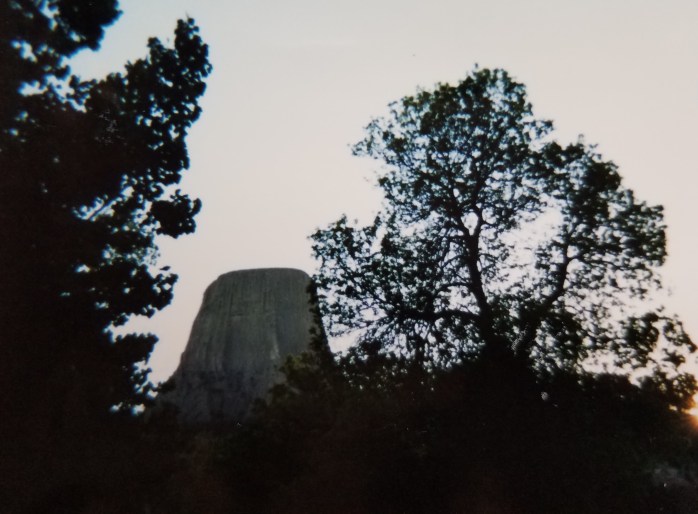
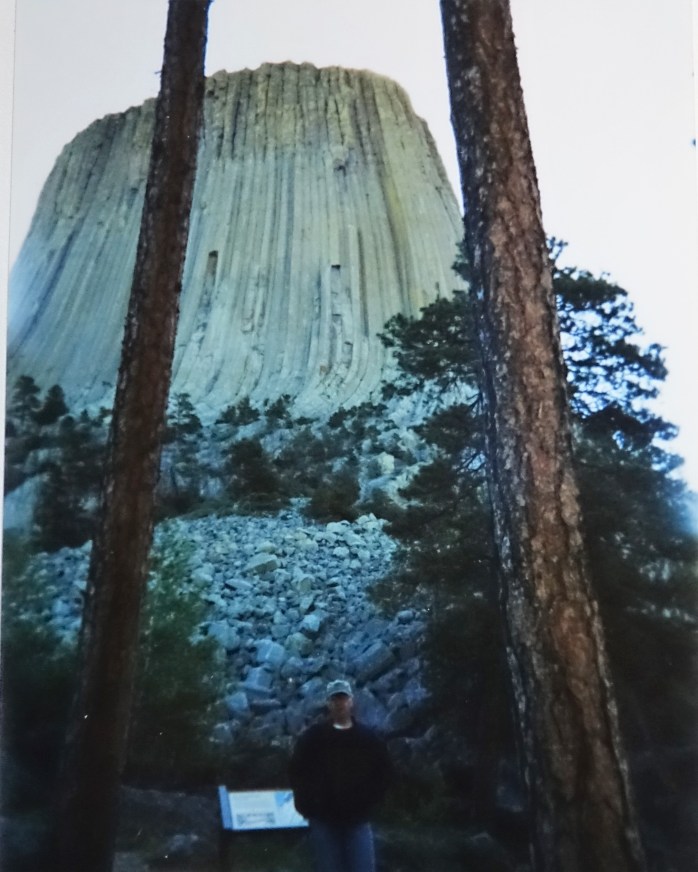
We were delighted to discover our campground was at the base of the 1,267 foot basalt tower and we fell asleep under it’s otherworldly presence.
The next day we walked the easy trail around the Tower enjoying the sunshine, breathing in the fresh piney air and watching climbers tackle the massive Rock.
Soon we would enter South Dakota where more adventures awaited: Mt. Rushmore, Custer State Park and Badlands National Park. Too much to tell here so I will save that for Part 2 of a ‘Journal through the American West.’
~ Susanne
Weekly Photo Challenge – Orange
Okay so I made it up myself. I miss the Weekly Photo Challenge and decided to do my own to carry me through the week.
The word is ‘orange’ of the sweet, juicy variety and also of the capital Orange variety, for here I am in Orange, California, enjoying sunny weather and temperatures in the mid eighties. Until Friday that is, when temperatures are expected to soar to a sizzling 105 or more depending on which weather app you believe. (!!!)
Here then to celebrate ‘orange’ are some photos from Old Town Orange where the oranges are tasty and the flag flies high in the town square.
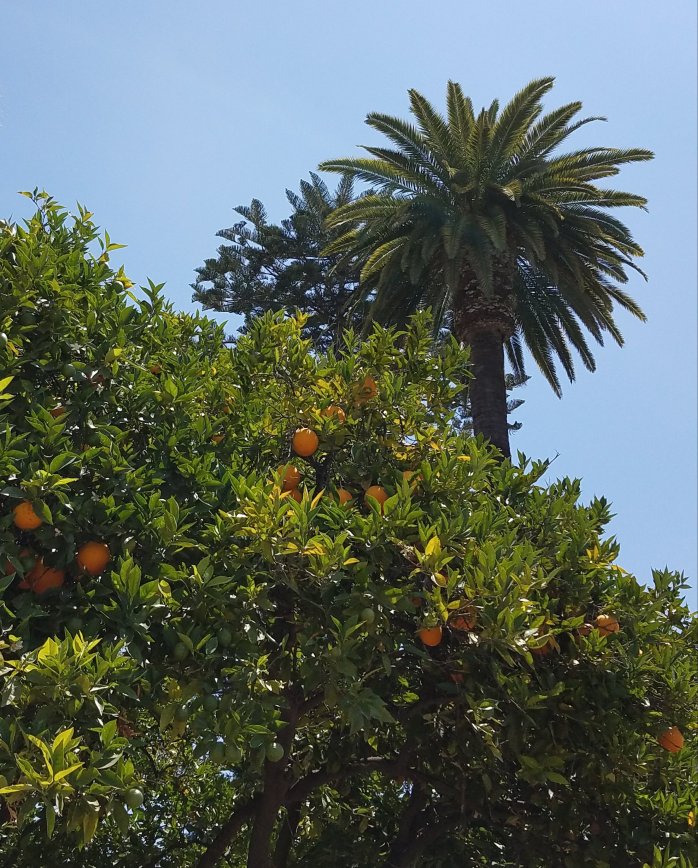


Orange!
Happy 4th of July.
– Susanne
Happy Benji
This is Benji and I love being a cat.

Everything I do makes me happy, especially whatever I am doing currently. Sleeping on my new perch is a good example.
First I take a deep breath and stretch as long as I can. You should try it – it feels so good!
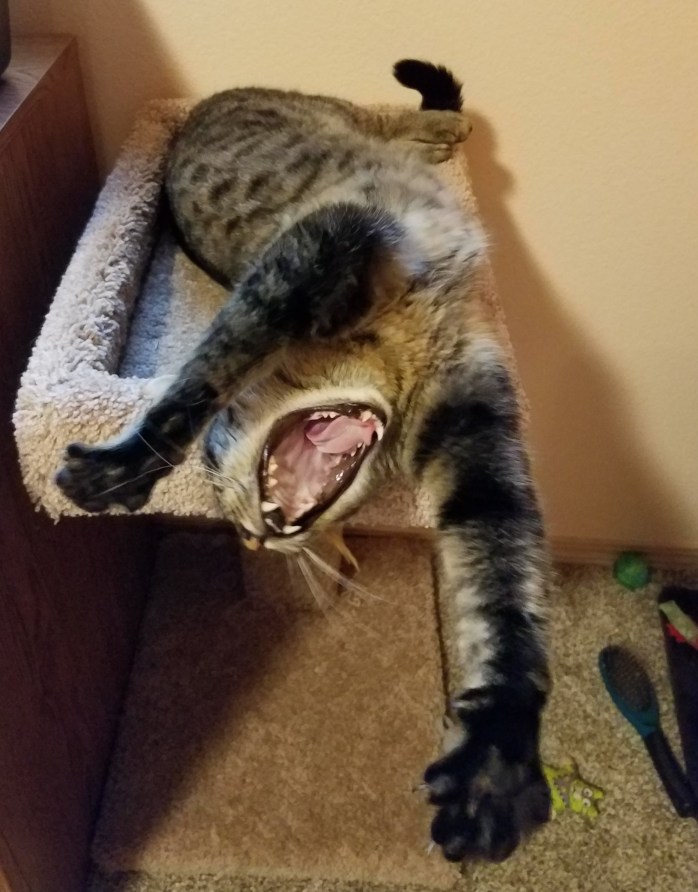
Then I turn this way and that to find the very best sleeping position which I enjoy as long as I can.
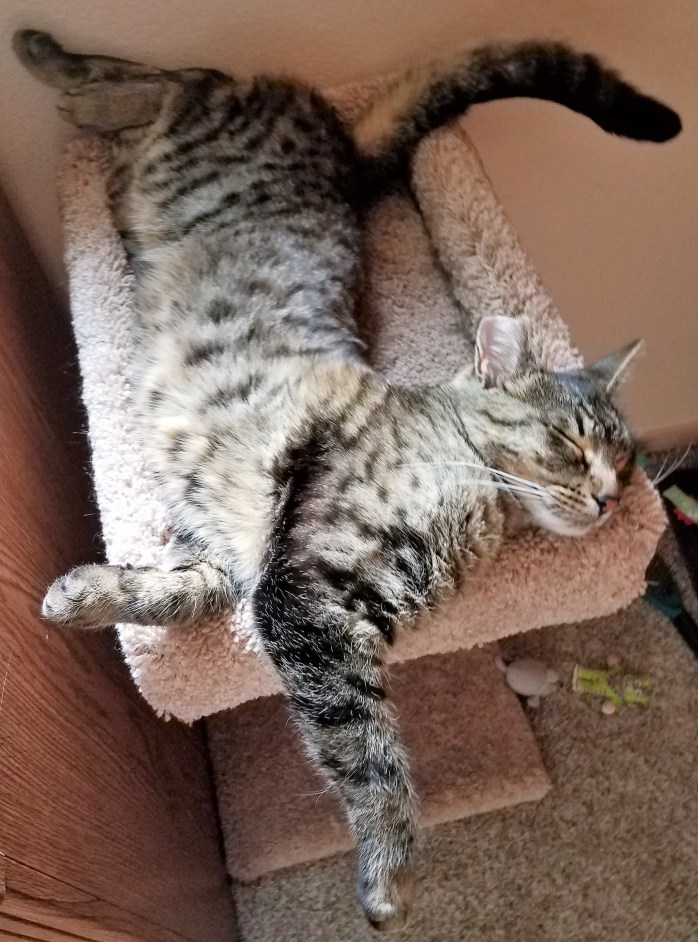
Sometimes I turn around just for the fun of it. All positions are good.

You might think I’m too big for my perch, but no, not at all.
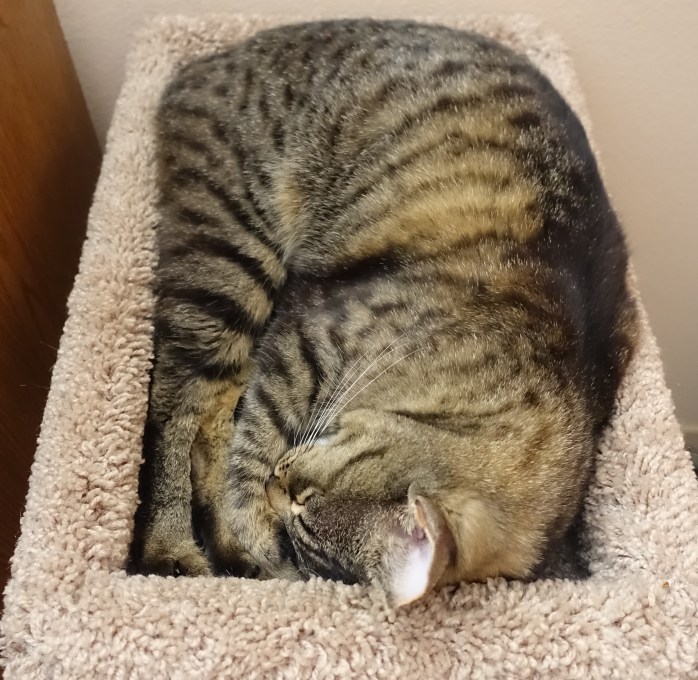
See how well I fit?
~ Benji
A shrimp story
A recent visit with a long lost cousin reminded me of our shared grandparents and history at Pleasant Harbor on Hood Canal.
Wisdom from Cats in the Garden
I wandered in the garden one morning

and found Tiger and Benji apparently at odds.
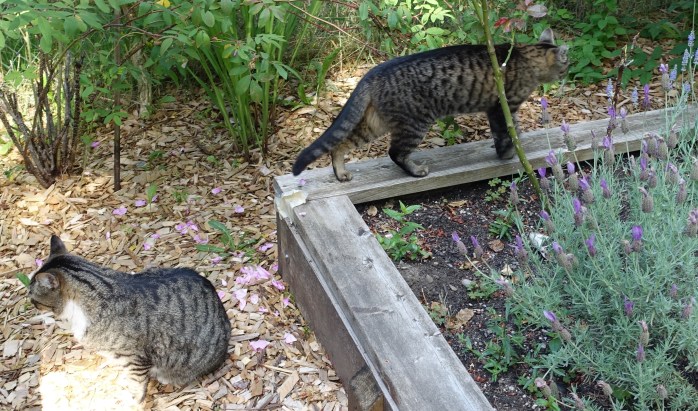
It was mostly Tiger who needed cheering up.
“Hey Tiger, you handsome boy! How are you doing?”
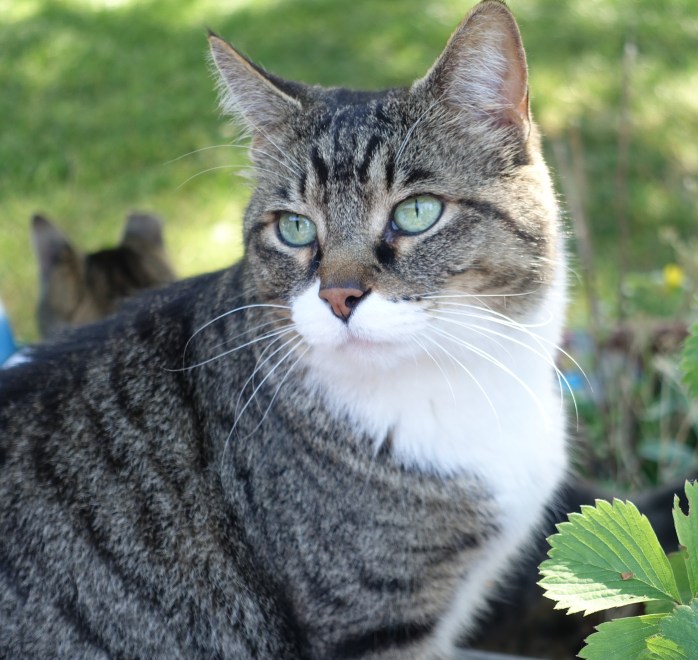
“Oh I don’t know Sue. I don’t feel very handsome. Did you notice the carcass in the yard?”
“Yes Tiger, I noticed. A mole. Great job!”
“It wasn’t me Sue. Benji caught it. That boy is fast! You should have seen him out here in the lettuce this morning. It was brilliant.”
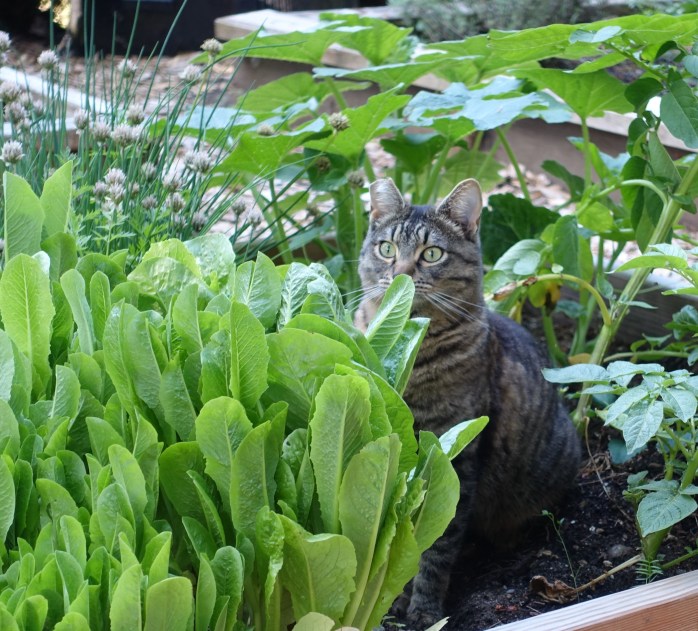
“He knew just when to strike and brought the beast down without a struggle.”

“That’s great Tiger,’ I replied. “The mole was destroying the garden and needed to go. I’m happy Benji took care of it. So what’s the problem?”
“Don’t you see Sue? I used to be able to do that. Not anymore. Let’s face it. I’m finished.”

“Oh Tiger, you mustn’t think that! You did your part. It’s time to let the boy do the dirty work. Who wants to kill moles anyway? They’re not good for eating.”
“You’re right about that Sue. But I just feel so useless sometimes.”

“You’re not useless Tiger! Your presence alone keeps the varmints away. Honestly, I love how you wander in the garden and enjoy the moment.”

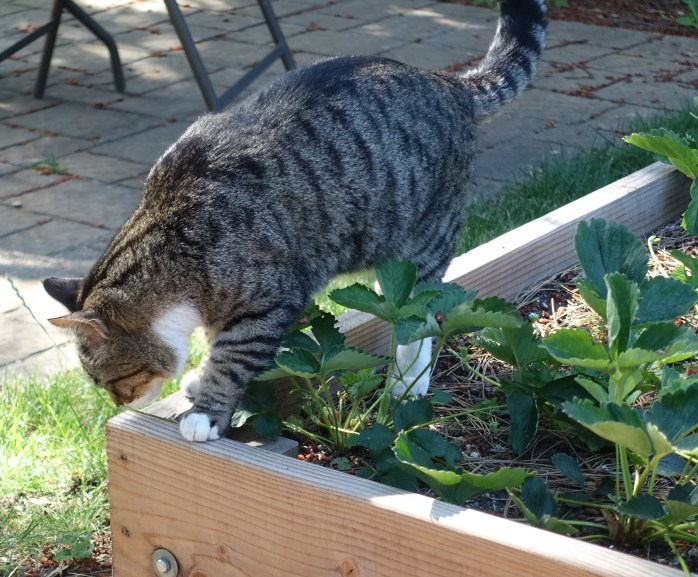
“You remind me to stop and take time to smell the roses.”

“And the lavender.”

“And the bounty of the garden. Did you notice the raspberries are ripening?”

“And look! Our first year for thimbleberries!”

“Yes Sue, I noticed. And how about those strawberries? They really smell good!”

“Indeed they do Tiger! Youth has its place, but if everyone ran around in a frenzy all the time, hunting and wild-eyed, how would it be? There’s got to be some mature felines to provide guidance and wisdom to the young. You’ve got a lot to give.”
“Aw thanks Sue. I could give Benji a few tips alright. I don’t really feel like hunting moles anymore, though I may be up for an occasional vole now and then. Mostly I’d rather be here where I am, in the garden visiting with you.”
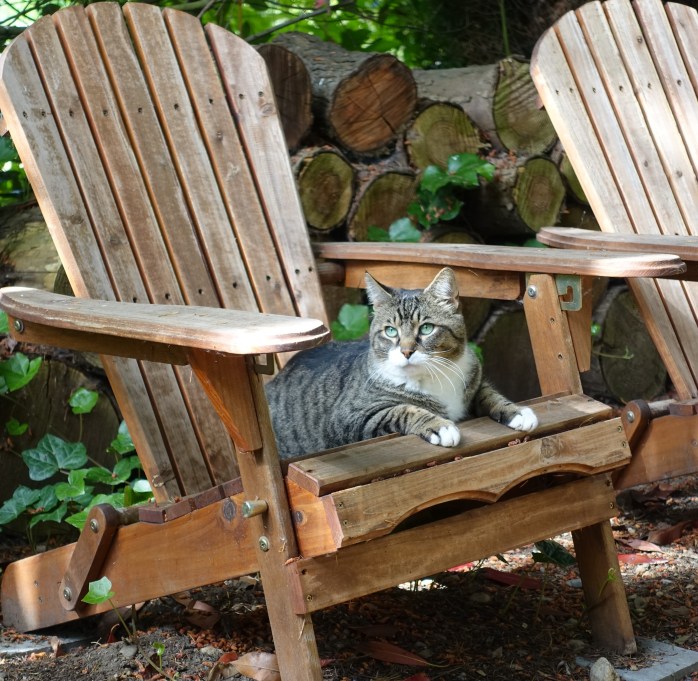
“You and I are more alike then you know, Tiger.”
~ Susanne
In the Zone
Sorry if you have to work today. I think I shall stay right here.
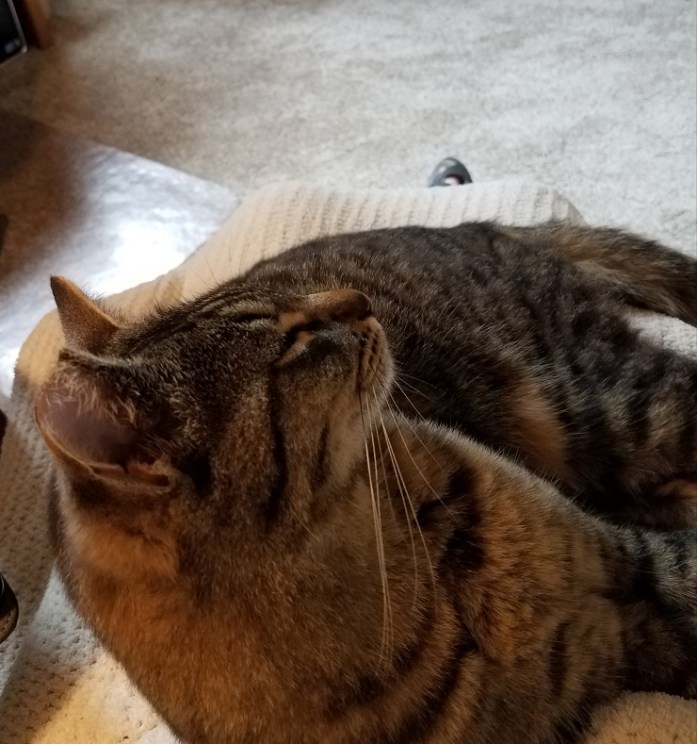
In the zone.
Happy Friday.
~ Susanne and Benji
Silver Falls at Mt Rainier
We were looking for someplace to escape the heat this week and decided on a trip to Mt. Rainier National Park. There’s always something new to discover at the Park and this week it was Silver Falls. On our way to the Falls, we enjoyed views of the Mountain around every corner.
This one from Inspiration Point.

This one at Reflection Lakes where we got to see the mountain twice
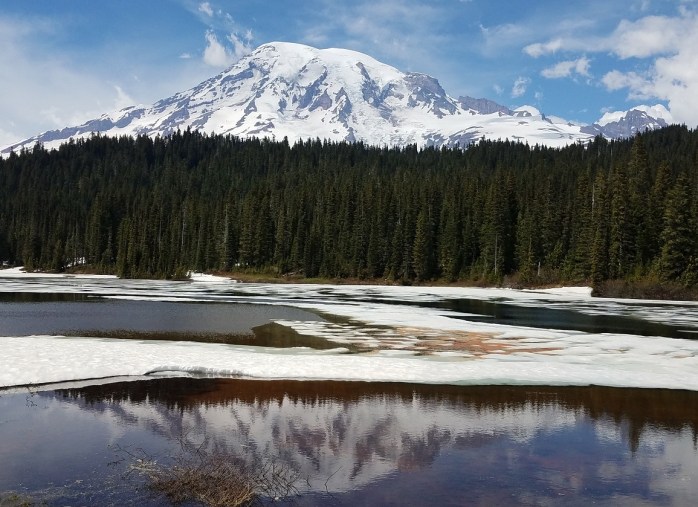
and framed in evergreens.

Along the Stevens Canyon Road we continued toward Ohanapecosh Campground and the trailhead to Silver Falls. Turns out it had everything you want in a hike.
A good trail through towering old growth forest.
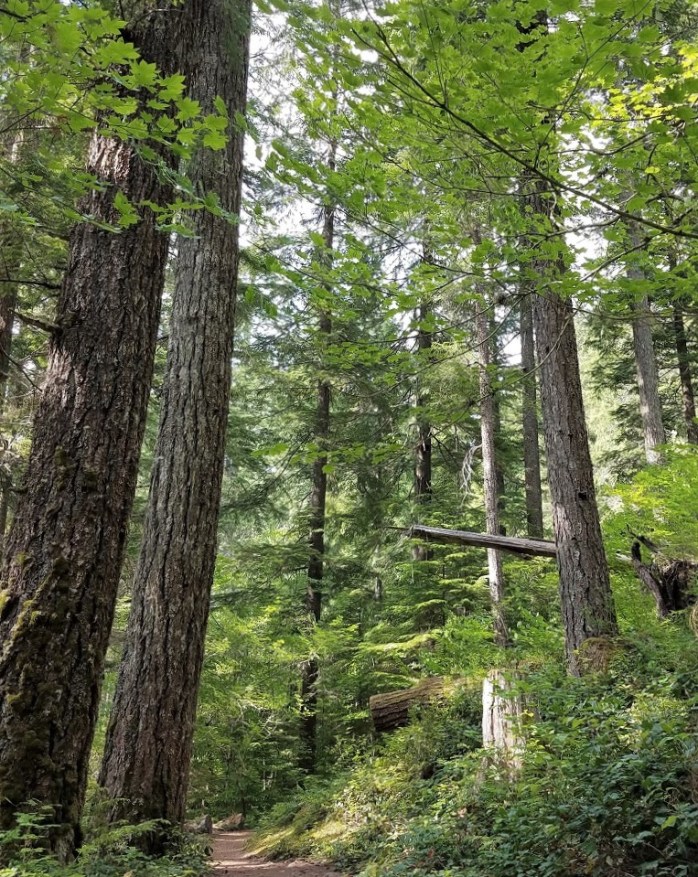

Bridges over streams and brooks.

The roar and occasional glimpses of the river through the trees.

And the gorgeous falls at the end, where according to the National Park Service website, “the clear, icy and swift Ohanapecosh River tumbles over Silver Falls as it flows from its headwaters in the glaciers and snowfields on to the sea.”

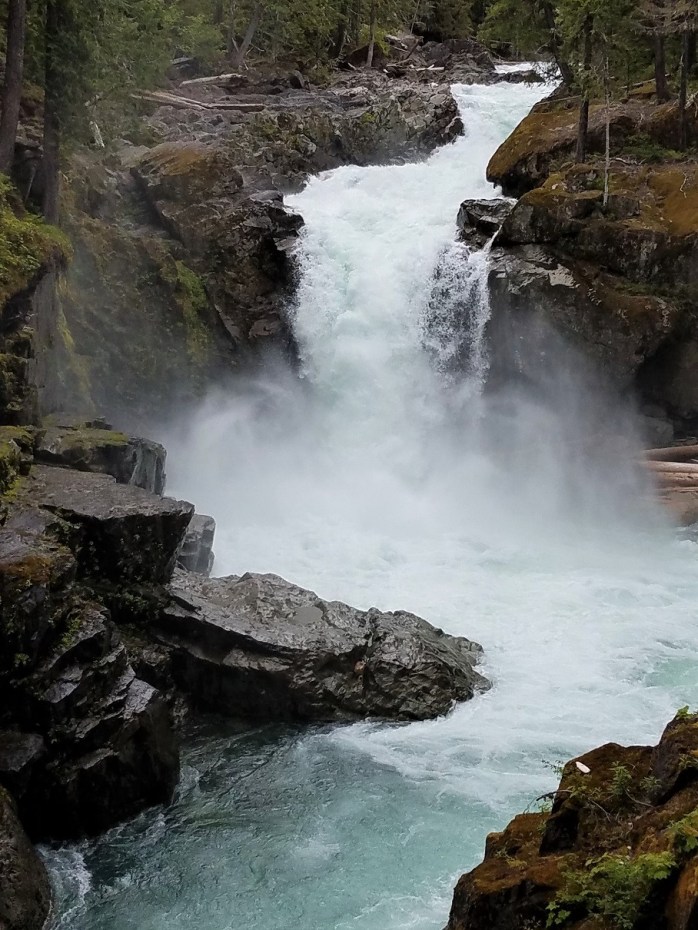
Ahhhhh yes. I can feel the cool air even now.
Move over Sol Duc. I think I found my new favorite waterfall hike.
~ Susanne
Disabling Spammy Comment Likes
Most of you won’t need to read this post as it applies only to those who regularly comment on my blog. I woke this morning to notifications of a spammer ‘liking’ comments on my recent posts. The name starts with ‘id’ and is followed by randomly generated letters. I assume they wish to trick you into visiting their site. I did not and I wanted to spare you as well. I reported the matter to WordPress and they were already aware of the issue and working on blocking this activity. Their workaround for now is to disable comment likes which I have done. (You’ll find a check box that controls this under Sharing Options.)
I decided to write this post as I’ve been helped when other bloggers have warned of specific spammer activity.
I still welcome your comments on my blog and will respond as always. But for now I won’t be able to ‘like’ your comment in order to thwart the pernicious ‘likers’.
Isn’t blogging fun?
~ Susanne
A Summer Sunset
Though summer doesn’t arrive till Thursday the weather couldn’t wait and we reached 85 degrees today. Along with high temperatures expected all week, the summer solstice will also bring the longest day of the year. In Seattle that means a whopping 16 hours of daylight, with sunrise at 5:11 a.m. and sunset at 9:10 p.m. It rather makes up for those dark, dreary days of winter, don’t you think?
And what better time of year to enjoy the sunset! Driving home last night while the sun was setting we could tell it was special so we swung by a new spot to watch it. These pictures were taken at 9:20.


Look closely and you’ll see the Seattle skyline far off in the distance and Lake Washington shimmering to the right.

I only had my phone with me so the quality of the pictures could be better. Still the sunset speaks for itself.
Looking forward to returning to this spot to enjoy more sunsets of summer with real camera in hand.
~ Susanne
A Camper, Submarines, and Poulsbo
One of the nice things about shopping for a camper is that it takes you to places you might not otherwise go. Take yesterday for instance. We’d found a trailer for sale in Seabeck and wanted to take a look. Located on Hood Canal, we knew we could get there by going north and taking a ferry across Puget Sound, or south and around on the Tacoma Narrows Bridge. It would be a fun day whether we got the camper or not.

We opted to go south and over the Bridge.

The seller wouldn’t be home till later so we stopped for lunch in the charming town of Poulsbo. Founded by Scandinavian settlers on Liberty Bay over 100 years ago, Poulsbo has kept its proud heritage alive. Nicknamed ‘Little Norway,’ its historic downtown has colorful shops and eateries while its waterfront has views of the Bay, a pavilion and boardwalk.


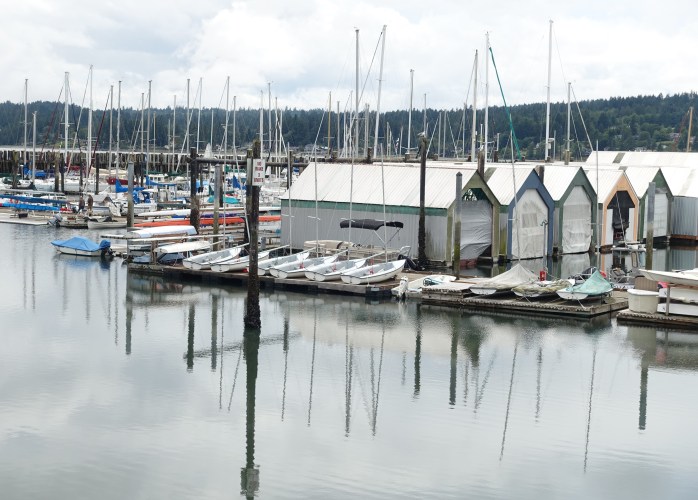

After a lunch of fish and chips and a bit of shopping it was on to Seabeck to check out the camper. Along the way I saw a sign which I thought said, ‘underwater war games.’ Really? Of course I’d heard of Bangor before and was vaguely aware that submarines navigated the deep waters of Hood Canal. Still it gave me pause.
We met the friendly couple selling the camper and I learned that both of them worked at the Naval Base nearby. In fact when I asked the wife about the badge she wore, she said she worked at the ‘top secret’ naval station. ‘Top Secret,‘ she said. Another reminder that in the midst of our paradise lies a fleet of nuclear submarines and ballistic missiles. I guess as long as they’re just playing games nobody gets hurt?
The Kitsap Naval Base was created in 2004 by merging the former Naval Station Bremerton with Naval Submarine Base Bangor. You can see the restricted area near Poulsbo on the map below.
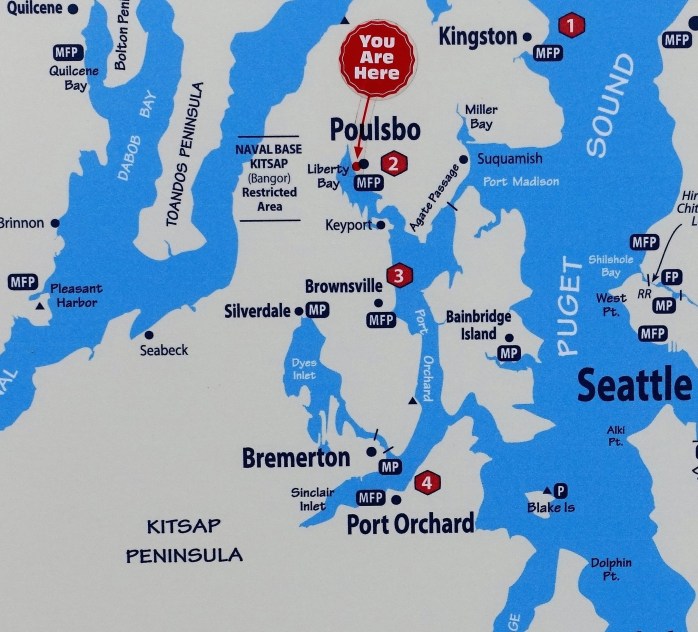
But we were there to see the camper. It was a beauty and well maintained by the nuclear submarine mechanic husband. Unfortunately it was too big for our needs and our truck, to which we were unable to hitch it. So after a stop for dinner we headed back home over the Tacoma Narrows Bridge, without a camper, but having had a fun and interesting day nonetheless.
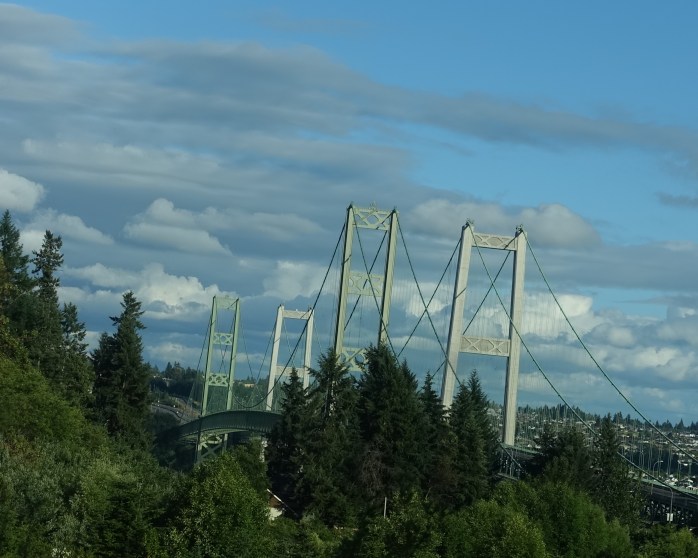

We will continue our search for the perfect camper wherever that may lead us. Another day, another story.
~ Susanne
 Cats and Trails and Garden Tales